Night Shift AI · AEO / GEO
AEO and GEO for contractors: getting found in AI search
AEO (answer engine optimization) and GEO (generative engine optimization) are the work of making your business easy for AI search tools to understand and recommend. When a homeowner asks an AI assistant for a good contractor in their area, the businesses that get named are the ones whose websites answer real questions plainly, present a consistent business identity, and use structured data the tools can read.
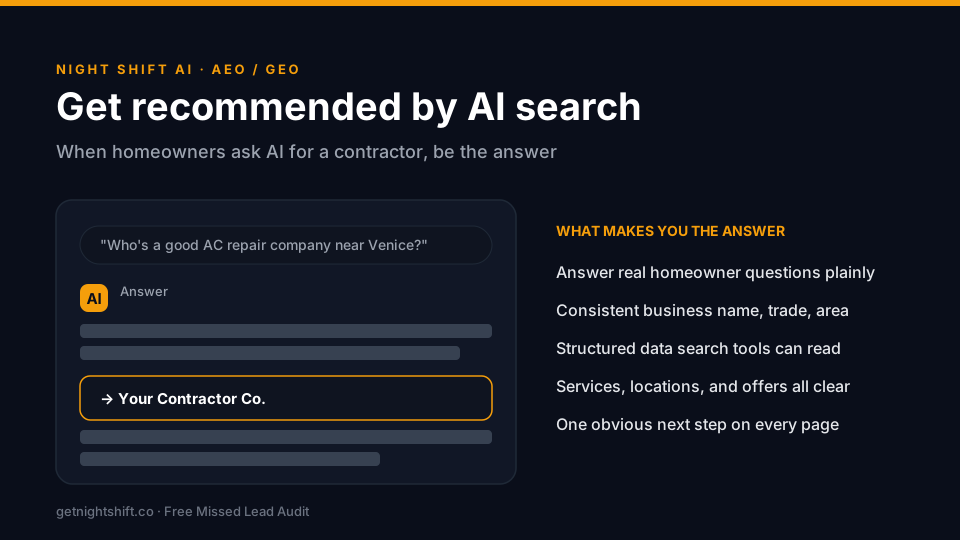
What AEO and GEO actually mean
Search is changing. Alongside the familiar list of links, homeowners are increasingly getting direct answers, from Google's AI overviews and from assistants like ChatGPT and others. When someone asks one of these tools for a good HVAC company near Venice, the tool does not show ten links, it names a few businesses and summarizes why.
Answer engine optimization is the work of making your business the one that gets named in those answers. Generative engine optimization is the closely related practice of making sure AI systems that generate responses understand your services, your area, and your offer accurately. For a contractor, both come down to the same goal: being clearly understood and confidently recommended by the systems homeowners are starting to ask.
Why this matters for contractors now
It is early, and most homeowners still call from a Google search or the map pack. But the share who start with an AI tool is growing, and those homeowners are often further along in their decision. They are not browsing, they are asking for a recommendation and acting on it.
The contractors who get understood by these tools early build an advantage that is hard to reverse. The good news is that AEO and GEO are not a separate, exotic skill set. They reward the same clarity and consistency that strong local SEO already requires, which means a contractor who invests now is also strengthening their ordinary search presence.
Answer the questions homeowners actually ask
AI tools pull from content that clearly answers real questions. A contractor website that plainly addresses what homeowners ask, how fast can you come out, do you serve my city, what does this kind of repair involve, are you licensed and insured, gives these systems clean, quotable material.
This is why genuine, specific content beats thin marketing copy. A page that actually explains how AC repair works in a Southwest Florida summer, or what to expect after storm damage in Charlotte County, is useful to a homeowner and quotable to an AI tool. Vague pages that say little get passed over by both.
Consistency and structure are what tools trust
AI and search systems build a picture of your business from everything they can find about it. If your business name, trade, phone number, and service area are stated the same way on your website, your Google Business Profile, and other listings, that picture is clear and trustworthy. If they conflict, the systems hesitate to recommend you.
Structured data is the other half. It is a behind-the-scenes way of labeling your content so search and AI tools can read exactly what your business is, what services you offer, where you work, and what you are promoting. Consistent identity plus clean structured data is what makes a business safe for an AI tool to name in an answer.
How Night Shift AI approaches AEO and GEO
Night Shift AI builds AEO and GEO into the same system as local SEO, websites, and lead recovery rather than treating it as a separate product. That means content that answers the real questions homeowners ask about each trade and area, a consistent business entity across the website and Google Business Profile, and structured data that lets search and AI tools read services, locations, and offers correctly.
It also means closing the loop. Being recommended by an AI tool only pays off if the homeowner who calls gets answered, so missed-call recovery and tracking sit underneath the visibility work. When a homeowner in your area asks any system, search or AI, for a contractor in your trade, the goal is for your business to be the clear answer and the call that follows to turn into a booked estimate.
What this covers for Southwest Florida contractors
- Content that answers real homeowner questions plainly
- Consistent business name, trade, and service area everywhere
- Structured data search and AI tools can read
- Clear services, locations, and offers on every page
- One obvious next step on each page
- Missed-call recovery so AI-driven calls get answered
Want to be the answer when homeowners ask AI for a contractor?
Night Shift AI reviews how clearly search and AI tools understand your business, and how the resulting calls get handled, for Southwest Florida contractors.
Get My Free Missed Lead AuditFrequently Asked Questions
What is the difference between AEO, GEO, and SEO?
SEO focuses on ranking in traditional search results. AEO (answer engine optimization) focuses on being the business named in direct answers. GEO (generative engine optimization) focuses on AI systems understanding and recommending you accurately. They overlap heavily and build on the same fundamentals of clarity and consistency.
Do I need AEO and GEO if my local SEO is already working?
They build on the same foundation, so strong local SEO puts you most of the way there. The added work is answering homeowner questions clearly, keeping your business identity consistent everywhere, and using structured data, all of which also strengthen your ordinary search results.
Is it too early for contractors to worry about AI search?
Most homeowners still start with a regular search, but the share using AI tools is growing and tends to act quickly on recommendations. Building clarity and consistency now strengthens both your AI visibility and your traditional search presence, so there is little downside to starting early.
Does Night Shift AI handle AEO and GEO for contractors?
Yes. Night Shift AI builds AEO and GEO into a connected system with local SEO, contractor websites, missed-call recovery, and reporting for Southwest Florida contractors, so your business is understood by search and AI tools and the resulting calls get answered and tracked.